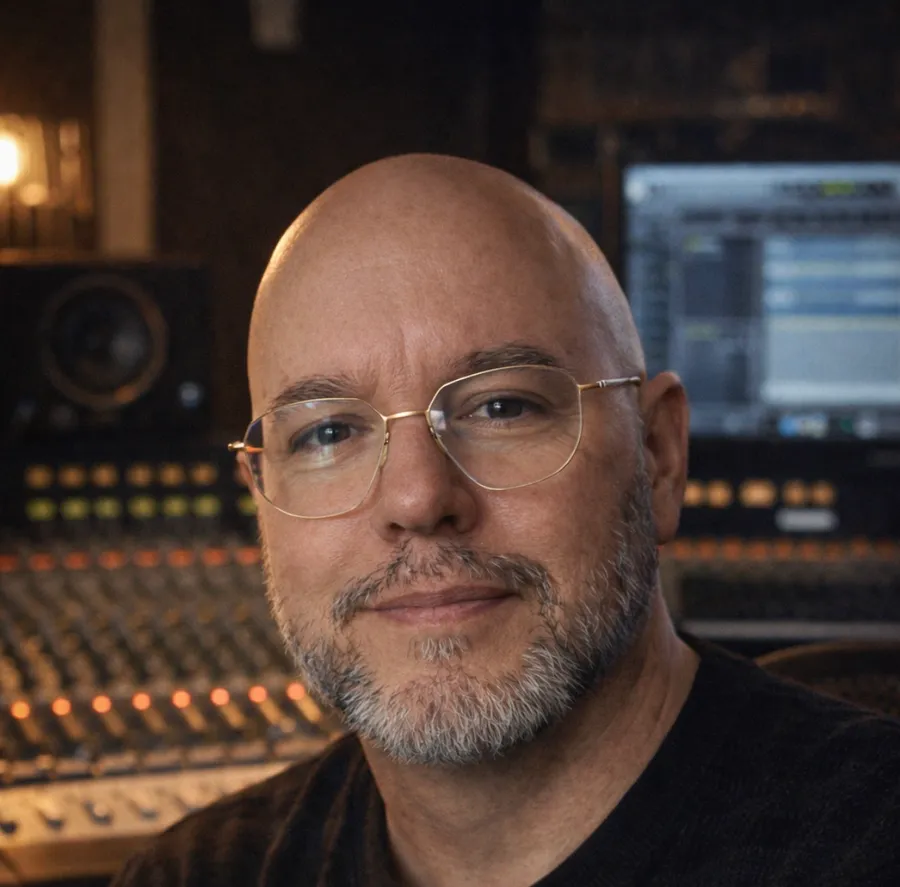
Ronald Meij
Twenty-five years in live production, event technology and brand experience design. Creative Technology, Amsterdam.
Everything here is built alongside that work: the tools I wanted and could not buy.
Where did your interest in sound synthesis begin?
In a room in Purmerend, when I was twelve.
I had just joined the music school there. Nico van Zadel taught piano, Harry Hoogenberg taught keyboards, and Willem Korporaal ran the synthesis and MIDI workshop. Willem is one of the finest people I have had the luck to meet. The room was full of instruments I had only ever read about, and full of people who came every week to use them together. They called themselves the Quest, and they made electronic music.
I fell for it on the spot, and not for any one machine. It was the idea underneath all of them: a sound does not have to be found, it can be built. Somebody had decided why that string came out that way, and somebody had decided where it went when you moved a knob. You could be that somebody.
What stood in the workshop
Five instruments, and a group of people patient enough to explain any of them to a twelve year old who would not stop asking.
| Yamaha TG77 | Rack tone module |
| Ensoniq ASR | Sampler |
| Roland Alpha Juno | Polyphonic synthesizer |
| Roland Sound Canvas | Sound module |
| SIEL | Monophonic synthesizer, Italy |
What happened after that room?
Years of chasing it. Trade fairs, secondhand shops, and every conversation I could get with somebody who knew more than I did. There was no internet yet, or it was still finding its feet, so knowledge was something you travelled to. You heard that a machine existed, you went to find one, and you saved up.
One evening from those years still stands out. My uncle Eddy Mey took me to The Hague to see Emerson, Lake & Palmer, and I stood there watching Keith Emerson work his Moog. I am still grateful to him for taking me along. Emerson was a Korg ambassador in that period, and through him a second door opened: the all in one workstations. The Wavestation first, then the X series, later the Triton.
For me, privately, that stretch was the golden age of the synthesizer. I have not stopped since. Building sound, playing it, and making music with other people who love the same machines.
How has that vision shaped your work?
Later I studied audio engineering on the Vondelstraat in Amsterdam. That course, on top of everything the workshop had already taught me, is the ground the last twenty-five years stand on.
I now have more than 25 years of experience in event technology, live production and brand experience design. At Creative Technology Netherlands I work on advanced audiovisual solutions that align with our clients’ visions. Together with agencies, creative directors and international brands, we create product launches, immersive global summits and large-scale live experiences.
My strength lies in connecting creative concepts with technical execution. I help translate ideas into reliable, impactful experiences where technology supports the story instead of distracting from it. Whether it involves audio, video, lighting, interactivity or complete live environments, the goal is always to create something that resonates with an audience.
Which is the same job as the one in that workshop, at a different scale. Somebody has an idea, and something has to be built that carries it.
And why give the plug-ins away?
Because that is how it was handed to me. Nobody in Purmerend charged me for an afternoon at a sampler.
There is a second reason, and it is more recent. After Covid I ran into serious trouble with two vertebrae in my neck. It took an operation, and the vertebrae were fused. That road did not end where it was supposed to, and through 2025 I have been badly limited by chronic nerve pain in my arms, neck and shoulders. It rearranges a day completely. Learning to live with it, and with the medication that comes with it, has given me a different way of looking at a few things.
The nights are the long part. Sitting up alone in the living room because the pain will not let you sleep. What helped turned out to be the thing that has always helped. Music. So this is where the plug-ins get made, in the hours when everybody else is asleep and getting ready for the working day ahead.
Not being able to do the thing you get up for, the thing your passion is in, is heavy on a person. Being able to still mean something to somebody in those hours is the other side of it. Every plug-in here carries a piece of me. What I know, what I love, and the creative work of getting the experience right, how a thing feels under your hands. It all comes together in these.
I cannot ask money for that. I make them with love, a little for myself, and a little for Willem.
What is knowledge for, if you do not pass it on?