MEY 640
Gravity · Surround Mastering Compressor
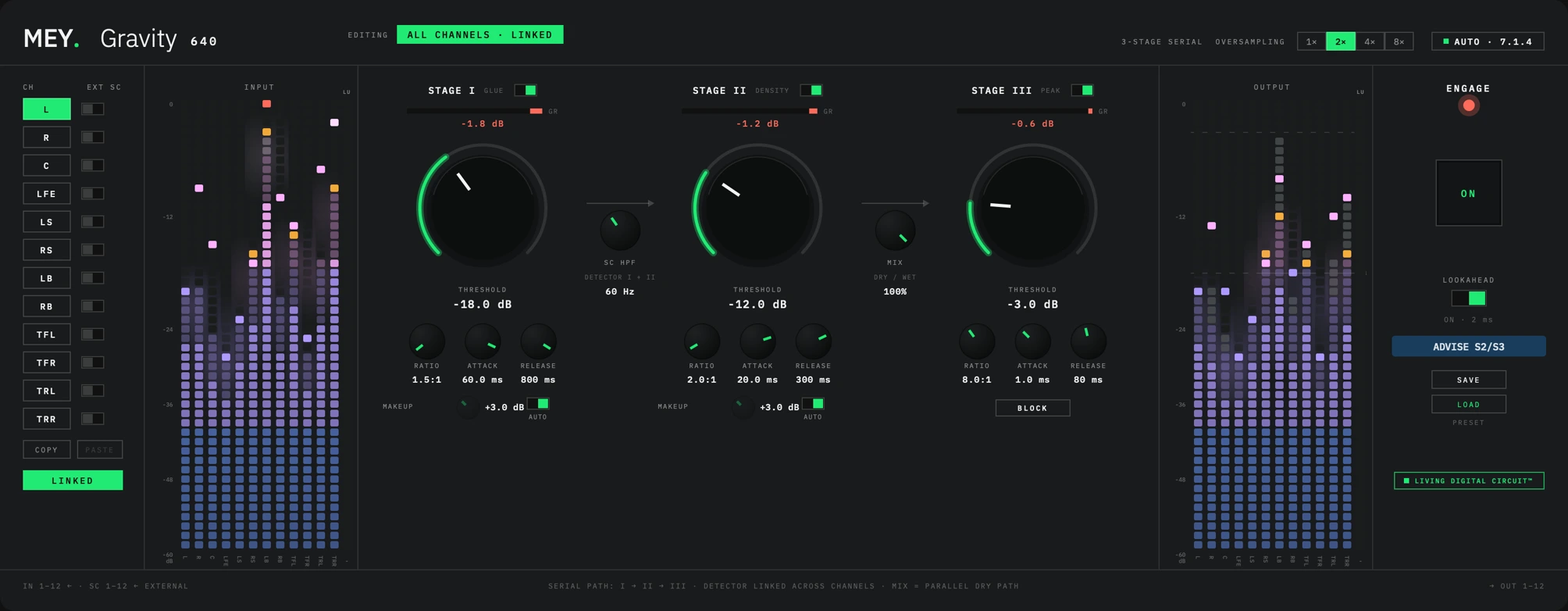
A three-stage mastering compressor built for surround and stereo classical masters. Glue, Density and Peak run in series, tuned on real orchestral material rather than borrowed from a general-purpose preset. A coupled detector keeps the image standing still under compression, and a single MIX control blends a phase-matched dry copy back in for parallel compression across all three stages at once.
An exceptional plug-in. Not a compressor, not a limiter: it controls dynamics inaudibly and without colouration. Outstanding specifications. A must-have for any engineer who takes their craft seriously.

Free to use. Not free to build.
Every plug-in here starts as a research problem before it's a product: working out how a room actually behaves, or how a circuit actually ages a signal, and then testing that model until it holds up on real material. That takes real computation, plugin-framework and code-signing licences, and increasingly the AI-assisted compute that lets one person work through that much DSP and testing without a studio behind them. None of that is charged to you. If MEY 640 has earned a place in your sessions, a donation helps keep the next one coming. It's entirely optional and changes nothing about what you already have.
Three stages, one honest chain.
MEY 640 is a surround-capable mastering compressor built around three serial stages (GLUE, DENSITY and PEAK), a coupled, gain-linked detector, and a hard-brickwall safety stage. It is designed for classical and acoustic repertoire, transparent by default, with the character living in the ballistics of each stage rather than in added harmonics.
By default, one gain-reduction value drives every channel in the bus: the loudest channel controls the whole stereo or surround image, so the image never tilts under compression. LFE follows that shared gain but never drives it. Switching to PER CH gives every channel its own parameter set and detector instead.
Mono to 7.1.4, detected automatically.
MEY 640 reads the host's channel layout and configures itself (mono, stereo, 5.1, 7.1, 5.1.4 or 7.1.4, main input matching main output) with a fixed internal channel order of L R C LFE LS RS LB RB TFL TFR TRL TRR. Channels outside the detected layout are dimmed and inactive; there is nothing to set by hand. An optional external sidechain bus, in the same layout, lets any channel key its detector off another source instead of its own signal, switchable per channel.
Glue, Density, Peak.
Factory defaults are deliberately gentle: soft ratios, slow times, shallow reduction. Stage III is the safety net, not the workhorse.
| I · GLUE | −18 dB · 1.5:1 · 60 ms · 800 ms · soft knee |
| II · DENSITY | −12 dB · 2:1 · 20 ms · 300 ms · medium knee |
| III · PEAK | −3 dB · 8:1 · 1 ms · 80 ms · hard knee |
Stages I and II use RMS detection with a smoothing pole on the gain itself, so a held double-bass note or an organ pedal isn't tracked as if it were the signal to compress. Stage III keeps a plain peak detector with no smoothing on purpose: a ceiling that responds to average level instead of the actual peak is not a ceiling.
All three THRESHOLD knobs read in the direction of compression, not the direction of dB. Fully closed (turned all the way left) means +12 dBFS (no compression at all), and opening the knob clockwise lowers the threshold and brings in more compression. Turning a threshold knob up always means "more," the way every other knob on the panel works.
Release that listens to the programme.
Release time isn't fixed to the knob value alone. A short, shallow reduction recovers on a fraction of the set time; a sustained, held-down passage recovers on the full set time: measured examples on real programme material show recovery around 161 ms after a short peak against roughly 789 ms after a sustained passage, from the same release setting. That keeps hall reverb and room tone from audibly "breathing" with the compressor, while brief transients still recover quickly.
Stages I and II each carry a MAKEUP control (−6…+12 dB) with its own AUTO toggle, unit-wide rather than per channel: per-channel makeup would tilt the surround image. With AUTO engaged, makeup is computed from that stage's current threshold and ratio: a fixed formula, not a metering feedback loop. Stage III carries no makeup by design: its threshold is the output ceiling.
A true safety ceiling.
BLOCK overrides stage III with an effectively infinite ratio, an instant attack and a hard knee: a true brickwall at the stage III threshold. With lookahead on, this holds a sample-accurate ceiling; at 44.1 or 48 kHz sessions, set oversampling to 8× if you're relying on BLOCK as a hard ceiling for that pass.
Two controls that sit beside the chain.
SC HPF feeds a high-pass–filtered copy of the signal to the detectors of stages I and II only (the audio path itself stays untouched), so a held bass note or a pipe-organ pedal can't single-handedly drive the gain reduction for the whole mix. MIX blends the fully processed signal against a phase-aligned dry copy at the very end of the chain: 0% is the untouched input, 100% is fully processed. Because wet equals dry below every stage's threshold, the blend is loudness-neutral by construction: nothing extra to compensate as you move it. This replaced the plug-in's original bleed taps, which were uncompensated parallel adds that could raise level by up to 6 dB and made a fair A/B impossible.
Built against broadcast standards, not green bars.
Input and output ladders share a 48-cell grid built from two commensurate scales that meet exactly on the cell boundaries, coloured in four named zones rather than one continuous tint ramp. A real over latches the ladder red until you clear it, so a missed clip can't hide behind the next quiet passage. Each stage's gain-reduction bar is drawn from the top of that stage's own level bar downward: the reduction actually being applied, not a separate bar from 0 dBFS. A short-term loudness column runs beside each meter bank, fed by a BS.1770-4 measurement taken independently pre and post the chain.
A starting point, not a suggestion engine.
One button computes a starting point for stages II and III from stage I's current threshold, ratio, attack and release: a fixed formula, no listening, no adaptation, no machine learning. The same stage I setting always produces the same advice, and you tune from there by ear. Stage III's advice is always the same fixed safety-ceiling setting; stage II's advice scales with how hard stage I is already working.
One image, or twelve channels of your own.
LINKED (default) means one shared parameter set, automatable from your host, and one coupled detector. Switching to PER CH hands both to the selected channel individually. COPY snapshots the selected channel's full parameter set; PASTE applies it to the selected channel, or to every channel at once while linked. SAVE PRESET stores the whole unit (every channel, every flag, every global), and LOAD restores it; there's one user preset slot per installation, not a library.
| Format | VST3 · Audio Unit · Standalone |
| Platform | macOS · Apple silicon · Windows |
| Channel layouts | Mono · Stereo · 5.1 · 7.1 · 5.1.4 · 7.1.4 |
| Channel order | L R C LFE LS RS LB RB TFL TFR TRL TRR |
| Sidechain | One external bus, per-channel source |
| Processing | Floating point · headroom above 0 dBFS |
| Oversampling | 1× · 2× · 4× · 8× (default 2×) |
| Lookahead | 2 ms, on by default |
| Metering | 48-cell grid · BS.1770-4 loudness |
| Version | 0.1.0, free |
A signed installer, no choices to make.
On macOS, download the signed installer and double-click it. It places the VST3 in ~/Library/Audio/Plug-Ins/VST3, the Audio Unit in ~/Library/Audio/Plug-Ins/Components, and the standalone app in /Applications. If macOS shows a Gatekeeper warning, right-click the installer and choose Open once, then confirm; this is only needed the first time. On Windows, unzip the download and copy the VST3 into C:\Program Files\Common Files\VST3. Restart your DAW or rescan plug-ins, insert MEY 640 on a stereo or surround bus, and confirm the AUTO badge shows the layout you expect.
More is coming.
This is v0.1.0: a first public build, tuned on real orchestral and classical material rather than a general-purpose preset. The full reference manual covers every control in detail. Feedback is welcome at info@wearemey.com.
Know someone who'd use this?
MEY 640 is free. Sharing it with someone who mixes or masters is the fastest way to help.