Halo 2000
Living Circuit Reverb
Four programmes, reverb and delay on separate clocks, early reflections and sub reverb as independent voices, and a headroom meter that tells you where you stand.
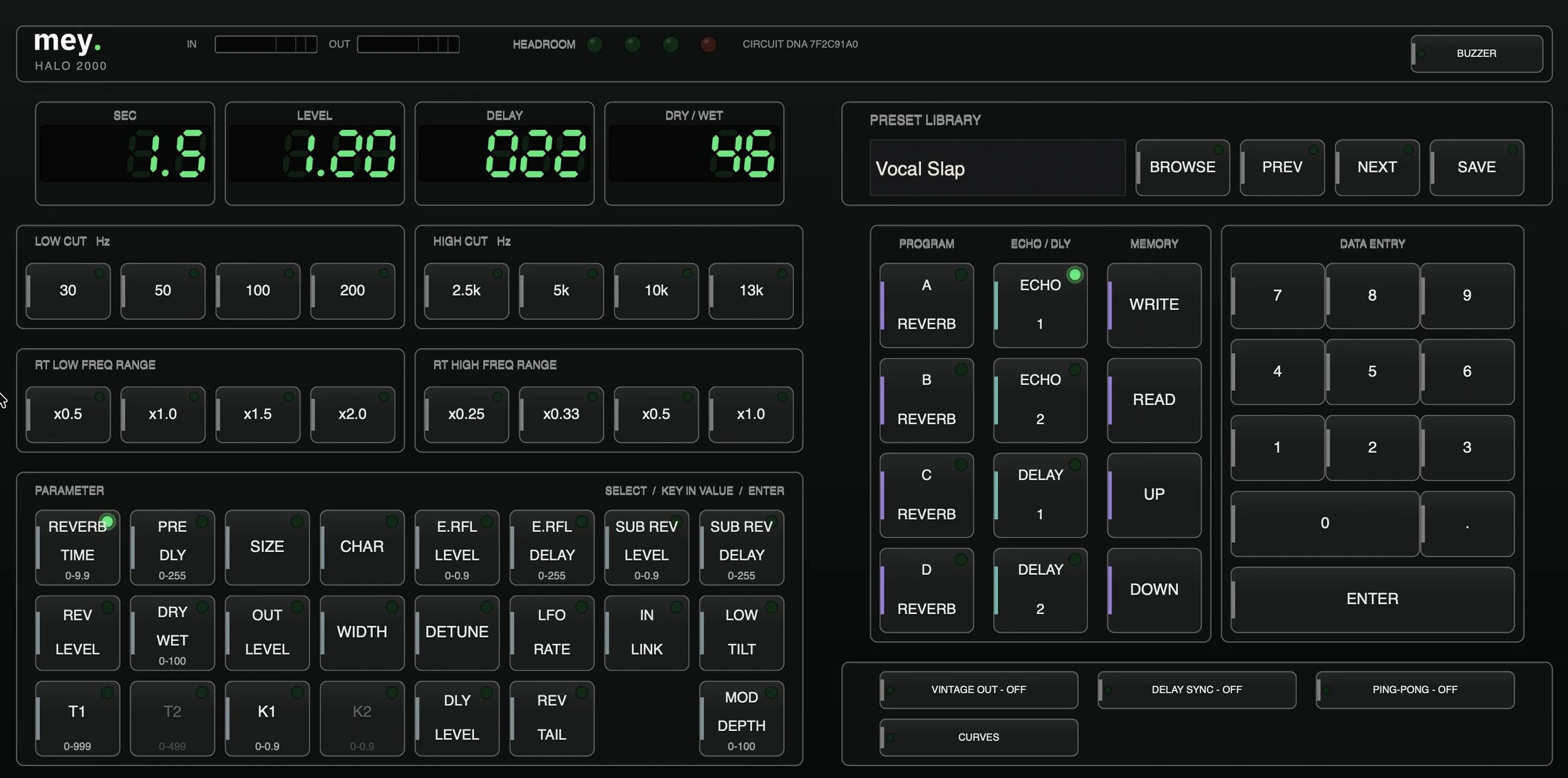
Complete remake of the DSP engine and user interface.
Halo 2000 has been rebuilt from the ground up: a new reverb and echo engine behind a hardware-style control surface, with four reverb programmes (A to D), separate echo and delay slots, a preset library with a data entry keypad, and independent low and high cut with their own RT frequency ranges. Existing macOS installations are notified of this update the next time they check in.
Free to use. Not free to build.
Every plug-in here starts as a research problem before it's a product: working out how a room actually behaves, or how a circuit actually ages a signal, and then testing that model until it holds up on real material. That takes real computation, plugin-framework and code-signing licences, and increasingly the AI-assisted compute that lets one person work through that much DSP and testing without a studio behind them. None of that is charged to you. If Halo 2000 has earned a place in your sessions, a donation helps keep the next one coming. It's entirely optional and changes nothing about what you already have.
Dry, then wet.
The same drum loop, straight through and then through Halo 2000. Nothing else in the chain: dry and wet play in step, so switching only changes the effect, never the level.
Space
Four reverb programmes, A to D, each held on the panel's PROGRAM column. Reverb time, size, character and early-reflection level are all live parameters, keyed in directly or dialled from the DATA ENTRY pad.
Echo and delay
Echo and delay run in their own section, with two slots each. DELAY SYNC locks them to your DAW tempo, and PING-PONG alternates the repeats across the stereo field when it's on.
Headroom
A meter that reads the input, not the softened output, so it warns you before the engine is driven hard. Four lamps, red on the last one.
A to D, kept and recalled.
PROGRAM A through D each hold their own reverb, and every echo and delay slot holds its own setting. The PRESET LIBRARY browses, steps and saves full states by name, and MEMORY plus the DATA ENTRY keypad write, read and dial in exact values the way a hardware unit would. VINTAGE OUT colours the output stage, and CURVES opens the frequency-response view.
| Format | VST3 · Audio Unit |
| Platform | macOS · Windows |
| Architecture | Apple silicon · Intel |
| Notarization | Trusted + stapled |
| Version | 2.3.0 |
| Price | Free |
| Machines | As many as you own |
| Activation | No account, no licence key |
| Updates | Included |
Know someone who'd use this?
Halo 2000 is free. Sharing it with someone who mixes or masters is the fastest way to help.