HALLE 1280
Multichannel Hall Reverb
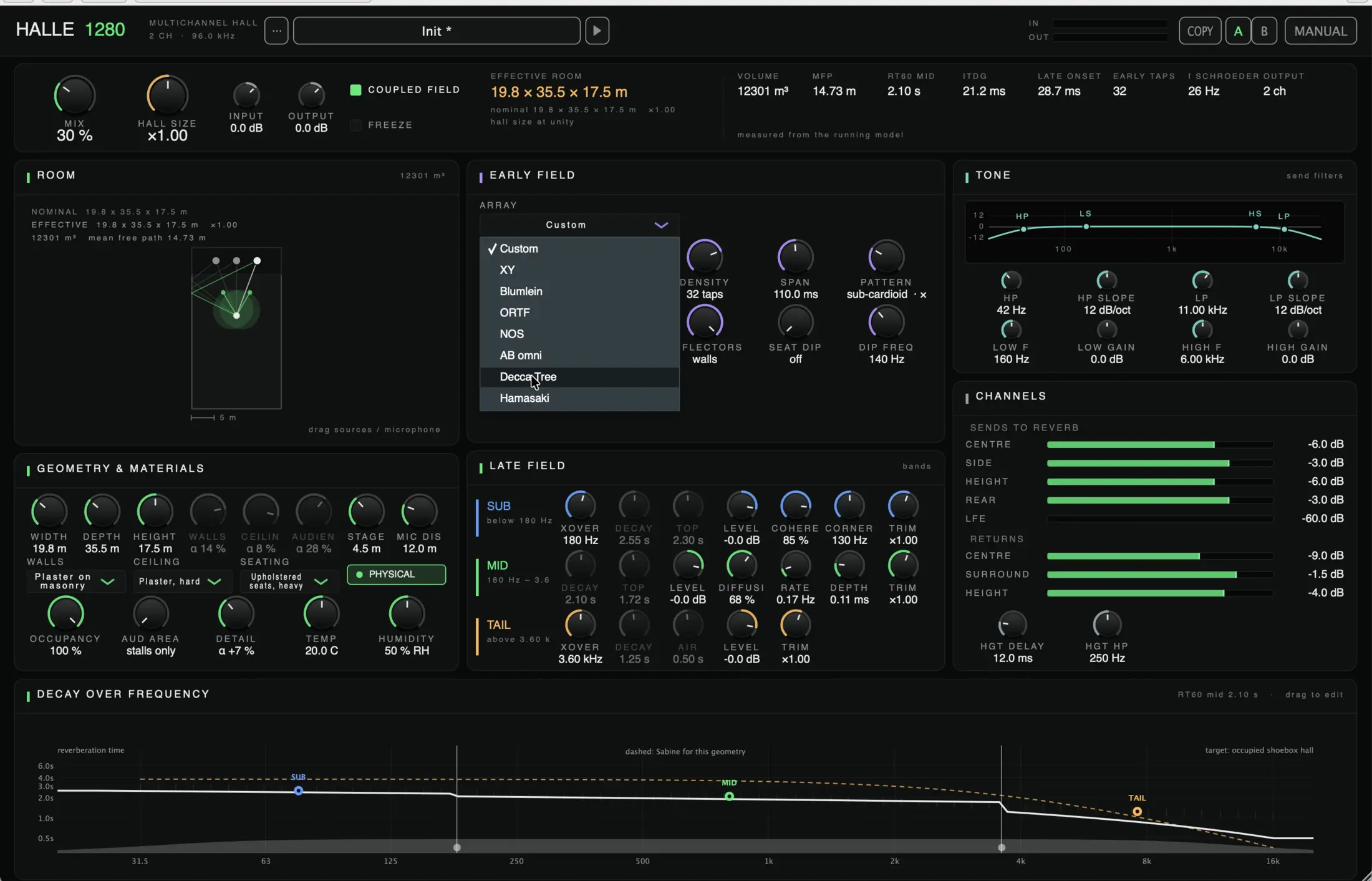
A hall reverb built from a room, not from a stored impulse. HALLE 1280 models a physical space (its dimensions, wall and ceiling materials, occupancy and air) and derives the early reflections and late field from that model, so every parameter you move is a physical one: width, absorption, humidity, microphone spacing. Early reflections come from a choice of real recording-technique microphone arrays, and the late field is split into three independently tuned bands.
The Halle 1280 is an impressive acoustic space generator. It delivers a powerful, detailed, and natural sound that brings out the true character of every recording. As a sound designer, I appreciate the combination of accuracy, depth, and realism.


Free to use. Not free to build.
Every plug-in here starts as a research problem before it's a product: working out how a room actually behaves, or how a circuit actually ages a signal, and then testing that model until it holds up on real material. That takes real computation, plugin-framework and code-signing licences, and increasingly the AI-assisted compute that lets one person work through that much DSP and testing without a studio behind them. None of that is charged to you. If HALLE 1280 has earned a place in your sessions, a donation helps keep the next one coming. It's entirely optional and changes nothing about what you already have.
A room, modelled. Not a captured impulse.
HALLE 1280 is a multichannel hall reverb that builds its sound from a physical description of a room rather than from a convolution impulse or an algorithmic tail. Width, depth, height, wall and ceiling material, seating and occupancy, temperature and humidity all feed a running model that derives the room's volume, mean free path, RT60, initial time delay gap, late onset and Schroeder frequency in real time: the numbers above the panel update as you move the controls, not just the sound.
COUPLED FIELD ties the early and late fields to the same room model; FREEZE holds the current tail indefinitely for pads and sustained textures. HALL SIZE scales the modelled room uniformly away from its nominal dimensions, and MIX, INPUT and OUTPUT sit alongside the field controls rather than inside the signal path.
Geometry and surfaces, not a size preset.
WIDTH, DEPTH and HEIGHT set the room's nominal dimensions directly in metres; the room diagram shows source and microphone positions, both draggable. WALLS, CEILING and AUDIEN set absorption coefficients per surface, each with its own material (plaster on masonry, hard plaster, heavy upholstered seating and others) and a PHYSICAL toggle that switches the model between idealised and measured absorption behaviour. STAGE sets the distance from source to stage edge and MIC DIS the microphone array's distance from the source.
OCCUPANCY and AUD AREA describe how much of the audience area is filled and which sections are occupied: a full hall and an empty one absorb differently, and the model accounts for it. DETAIL adds fine-grained scattering to the surfaces, and TEMP and HUMIDITY set the air's absorption of high frequency energy over distance, the way a warm, dry room and a cold, damp one give measurably different tails from the same geometry.
Real recording-technique arrays, or your own.
ARRAY selects the microphone technique behind the early reflections: XY, Blumlein, ORTF, NOS, AB omni, Decca Tree, Hamasaki, or CUSTOM for a pattern built from the remaining controls. DENSITY sets how many discrete early reflections (taps) are computed, SPAN their time window, and PATTERN the polar pattern used per capsule. FLECTORS chooses which room surfaces contribute reflections, SEAT DIP models the comb-filtering audience seating introduces at grazing incidence, and DIP FREQ sets where that dip sits.
Sub, mid and tail, decaying independently.
The late field splits at two crossovers into SUB, MID and TAIL, each with its own decay time, level and character: a room rarely decays at one uniform rate across the spectrum, and HALLE 1280 doesn't force it to.
| SUB · below 180 Hz | independent decay and top time · coherence · corner frequency · trim |
| MID · 180 Hz – 3.6 kHz | independent decay and top time · diffusion · modulation rate and depth · trim |
| TAIL · above 3.6 kHz | independent decay time · air damping · level · trim |
Each band carries its own DECAY and, where shown, a TOP time for the initial portion of the tail before it settles into the longer decay. COHERE (sub) controls how correlated the low end stays across channels; DIFFUSI, RATE and DEPTH (mid) add modulation to keep the tail from ringing on sustained material. The decay-over-frequency graph at the bottom of the panel plots all three bands against a dashed Sabine reference computed from the current room, so you can see at a glance how far the tuned decay departs from the geometry's theoretical prediction.
A send filter, not a channel strip EQ.
TONE shapes the signal feeding the reverb rather than the dry path: a high-pass and a low-pass with adjustable slope bracket the band, and a low shelf and high shelf sit inside them for broad tilt. HP and LP set the filter corners, HP SLOPE and LP SLOPE their steepness, and LS/HS with LOW GAIN/HIGH GAIN set the shelving points and their gain. It's the fastest way to keep a reverb from muddying a low end it was never meant to carry, or from hissing on top of a mix that doesn't need it.
Sends and returns for immersive formats.
The CHANNELS panel gives independent sends to the reverb for centre, side, height, rear and LFE, so a stereo source can be fed into the room asymmetrically and an immersive bed can place more or less of each channel group into the space. Returns bring the processed field back per group (centre, surround and height), each with its own level, and HGT DELAY and HGT HP shape the height return specifically, delaying it slightly behind the main field and rolling off its low end so overhead reflections read as overhead rather than as more bottom end.
Compare freely, name your own.
COPY duplicates the current state to compare against a variant, and A/B holds two full states for instant switching while you adjust one against the other. IN and OUT meters run continuously at the top of the panel, and the preset menu carries descriptive names for room type and treatment rather than references to any specific real venue. MANUAL opens the reference documentation from within the plug-in.
| Format | VST3 · Audio Unit |
| Platform | macOS · Apple silicon · Windows |
| Channels | Stereo through immersive height-channel busses |
| Microphone arrays | XY · Blumlein · ORTF · NOS · AB omni · Decca Tree · Hamasaki · Custom |
| Late field | Three independent bands: sub, mid, tail |
| Room model | Geometry, materials, occupancy, temperature, humidity |
| Derived readouts | Volume · mean free path · RT60 · ITDG · late onset · Schroeder frequency |
| Sample rate | Tested at 96.0 kHz |
| Metering | Continuous in/out, A/B compare, copy |
| Version | 1.0.0, free |
A signed installer, no choices to make.
On macOS, download the signed installer and double-click it. It places the VST3 in ~/Library/Audio/Plug-Ins/VST3 and the Audio Unit in ~/Library/Audio/Plug-Ins/Components. If macOS shows a Gatekeeper warning, right-click the installer and choose Open once, then confirm; this is only needed the first time. On Windows, unzip the download and copy the VST3 into C:\Program Files\Common Files\VST3. Restart your DAW or rescan plug-ins, insert HALLE 1280 on a return bus, and set ROOM and ARRAY to taste from there.
More is coming.
This is v1.0.0: the first public build of HALLE 1280, built around a physical room model rather than a convolution library. Feedback is welcome at info@wearemey.com.
Know someone who'd use this?
HALLE 1280 is free. Sharing it with someone who mixes or masters is the fastest way to help.