Slow Light
Ambient in D flat: forty-eight sounds from an empty patch, and every one of them is a presetWaveform
0:00/–:––We all need a Robbie
Everybody has one friend who never asks what the session is for, never wants to talk about gear, and is simply up for playing. Robbie is that friend as a synthesiser: sixteen voices, two oscillators and a sub, a filter worth driving. Nothing to set up. Load a sound, hit a key, lean on it.
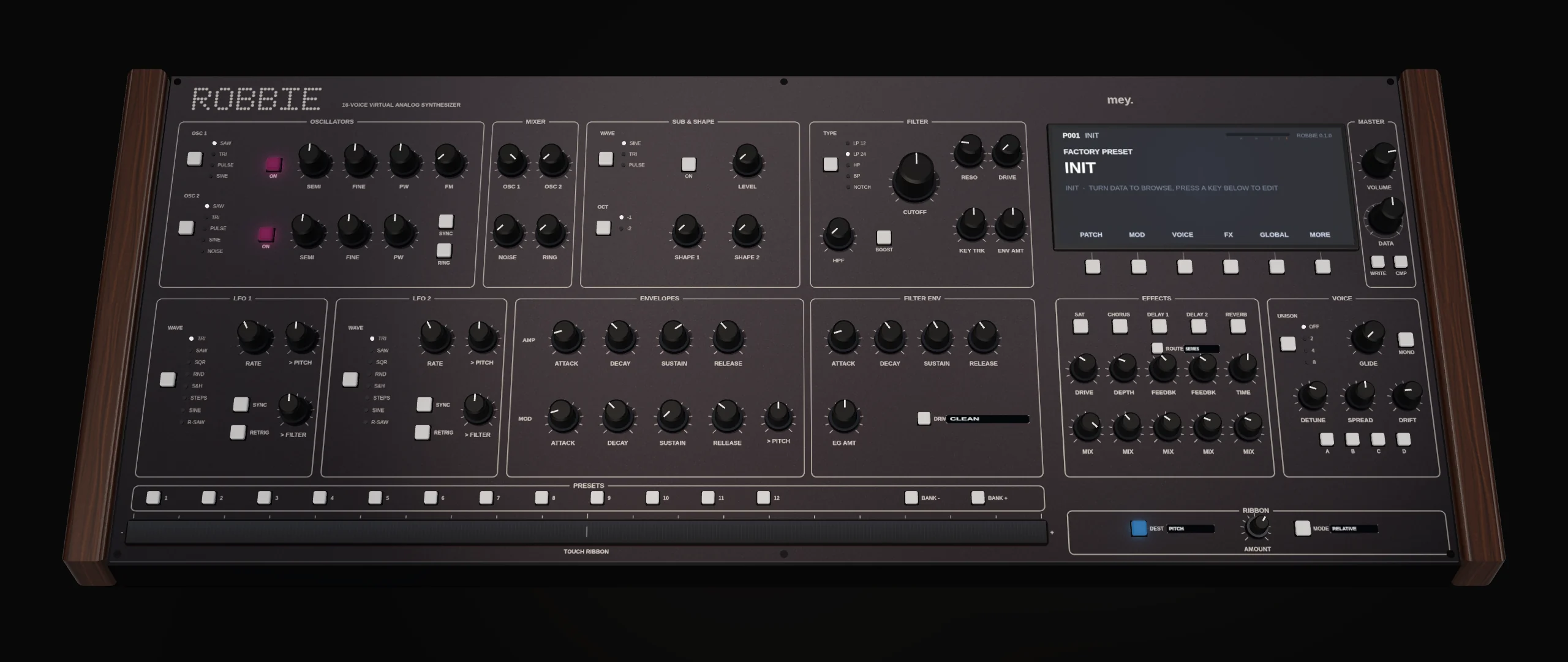
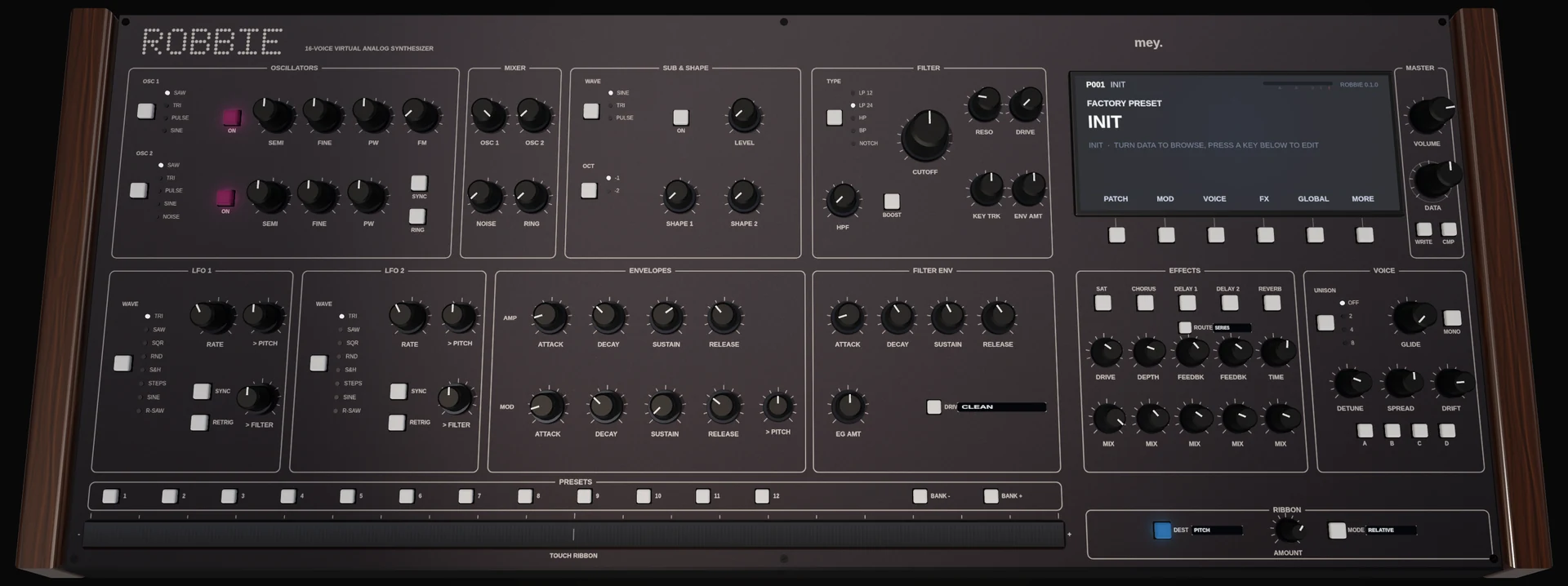
Robbie is free. Not a demo that nags, not a trial that expires, not a lite version of something better kept behind a shop counter. The whole instrument, all 613 presets, macOS and Windows, on Christmas Eve.
So here is the only thing we ask in return. A synthesiser like this costs a couple of hundred euros anywhere else. Take what you would have spent and buy someone else a present with it. Somebody who would never buy it for themselves. That is the whole deal.
Christmas Eve, six in the evening, Amsterdam time. Leave your address and you get one email on the day, with the two download links in it and nothing else.
I wrote these two for Robbie, and about Robbie. Every instrument you hear, the orchestra included, is a Robbie sound, played from a written score by the same engine you will run.
Lantern Sky is Robbie's dream. A slow waltz, the kind of tune that belongs on a music box, flying from one scene to the next: castles, an enchanted wood, a garden of little bells, a tunnel of stars, castles in the sky and a mischievous swamp, until the music box plays it home.
Phantasia Electronica is ten minutes in six movements. Robbie arrives in a big, empty house and waits for someone to play with it. Somebody does: the ghost of an old composer, who finds out what the instrument can do and writes his fantasy for it. It is written in the spirit of the old ballet music, and every note of it is new.
| I. The empty house | A clock ticks. Robbie asks its question, a phrase that climbs and stops halfway, and nobody answers. |
| II. A visitor | A harp, a celesta, and a flute that answers the question with its mirror image. Then the ghost sings a tune of his own. |
| III. The discovery | Robbie shows what it can do: an arpeggio, a filter sweep, a gliding bass. The orchestra answers every trick. |
| IV. Phantasia Electronica | The piece the ghost writes for it: a dance for three flutes and Robbie over pizzicato strings, with brass in the middle where Robbie lets go. |
| V. The waltz of the lanterns | The whole house dances: horns, strings, choir and Robbie together. |
| VI. Coda | The clock comes back. Robbie asks its question once more, and this time it answers itself. |
Horizon is the soundscape: long tones held for eight and sixteen bars, and everything else moving underneath them while nothing is touched by hand. Undertow is a film cue, dark, low and in no key, built on a twelve-note row. Euclid is acid electro where every rhythm, from the kick to which steps of the acid line sound, is a Euclidean one. Every note is written into a score and played by the same engine your host will run.
Two oscillators with a sub underneath them, a multimode filter with its own envelope and a resonant high pass in front of it, three envelopes, two LFOs, Poly Mod, a modulation matrix, saturation, a chorus that is also a flanger and a phaser, two delays that can be clean or bucket brigade, and a reverb. Sixteen voices, or one voice in mono and legato with a glide that behaves like the hardware it is modelled on. Four of these can run at once as separate parts on separate MIDI channels, which is what the Soundscapes use: one key, four instruments.
It is a virtual analogue, so the oscillators are band limited rather than sampled: a saw stays a saw at the top of the keyboard instead of turning into a bag of nails. Everything that can move is smoothed, nothing steps when you turn it, and changing preset takes the output down to nothing first and brings it back up over fifteen milliseconds, so auditioning sounds with a key held cannot click.
Robbie's front panel is a real object rendered in three dimensions, standing on a table in front of you, with wooden cheeks, a brushed anthracite plate and switch caps that light from inside. The light lands on the plate around them. That is not decoration: it is what tells your eye that a control is on before you have read a word.
The camera holds four positions, FRONT, TOP, SCREEN and RIBBON, and moves between them by itself. It never swings loose, because an instrument that drifts while you are trying to turn a knob is a toy. Click the empty part of a module and the camera leans in on it; click a knob or a switch and it does not, so you can work inside a section without the view sliding away.
The controls behave like hardware. Drag a knob up and down to turn it, hold shift for fine, scroll over it to nudge it, double-click to put it back where it started. The DATA encoder next to the display scrolls whatever list is open. Right-click anything and choose MIDI learn, then move a control on your keyboard: the next message it sends owns that knob, and the map is saved with your session rather than with the sound, so switching presets never moves your controller around.
The display is an OLED with six keys under it and a data wheel beside it, the way a stage synth has always done it, and every page behind those keys is a real page: patches, modulation, voice, effects, global. The whole manual lives inside the instrument, and hovering any control writes that control's line along the bottom of the screen. There is nothing to look up and nothing to keep in a folder.
Every factory sound is programmed as a performance rather than a snapshot. Velocity opens the filter and carries its own share of the loudness. Aftertouch leans on the cutoff and brings in the vibrato, so pressing into a held note does what pressing into a held note should do. The mod wheel is one escalation, from where the sound sits to where it goes. And the touch ribbon along the front edge is the wild card: assign it, then run a finger along it.
That is also why the panel is a panel. A list of parameters makes you configure. A plate with knobs on it makes you reach out and turn one, and then another, and then you have lost an hour. That hour is the entire point of the instrument.
Both oscillators do saw, triangle, pulse and sine, and oscillator two adds noise. SHAPE morphs continuously through that list rather than switching between them, which is where the waveforms that are not on any selector live. Add hard sync, ring modulation and FM from oscillator two, and a sub an octave or two under oscillator one that takes the note and nothing else: no detune, no morph, no unison spread, because a detuned sub is mud.
The filter is a multimode with twelve and twenty-four decibel lowpass, highpass, bandpass and notch, resonance that reaches self-oscillation, key tracking, and a drive that picks its own character: a soft tanh, an asymmetric diode ladder, a wavefolder or a bit crusher. In front of it sits a high pass that sweeps from twenty hertz to two kilohertz with a boost switch, which is how a bass gets out of the way of a kick without touching the filter you are playing with.
The filter has its own envelope, with its own attack, decay, sustain and release and an amount in semitones that goes negative, so the modulation envelope stays free for the pitch, the pulse width, the FM and the oscillator mix. Two LFOs with eight shapes run free or lock to the host, from a sixty-fourth note up to eight bars with a triplet and a dotted version of everything, and a modulation matrix routes what you want to where you want it.
Oscillator two can leave the keyboard and hold one pitch while oscillator one moves, or drop seven octaves and become a low frequency oscillator of its own, on every voice. That is what Poly Mod is for: the filter envelope and oscillator two, each with an amount in either direction, sent to the pitch, the shape and the pulse width of oscillator one and to both filters. Sweep a synced oscillator with the envelope, or put oscillator two at audio rate into the cutoff and listen to the filter growl. The high pass gets a resonance knob too, and turning it up takes it from a gentle one pole slope to a resonant two pole filter with a peak you can play.
In mono and legato you choose which key wins, the last, the lowest or the highest. Hold a chord and press UNISON and Robbie keeps it: from then on every key plays that chord, until you switch chord memory off again.
Robbie has a reverb: room, hall, plate and spring, in the fifth column of the effects section. The hall started from a measurement. We took a finished reference recording, found the one place where a reverb tail rings out on its own, and measured it band by band. Robbie keeps that hall's two and a half seconds in the mids and its two sides completely unrelated to each other, and then it is voiced warmer than the room it came from: the lows ring a little longer than the mids, the highs fade the way air takes them in a large hall, and thirty-two delay lines of prime lengths keep the tail dense and smooth, with nothing in it that rings like a box. A test measures the hall every time the instrument is built and holds it to that voicing.
The factory sounds live in it. Every sound that had a space of its own now sits in the hall, or in the room when it is a small one, and the sounds that should move do: every note of a pad, a string section, a pluck or a bell lands in its own place across the stereo field, and the slow ones drift while they sound. Bass, leads, mono voices and drums stay in the middle, where a mix wants them. A gentle glue on the output holds the loud moments together, and it only ever turns down.
An oscillator that says it is band limited and is not shows up as a handful of tones that have nothing to do with the note you played, sitting in the middle of the music. Robbie's oscillators are tested against a harmonic grid at both 44.1 and 48 kHz, and the number is whatever the measurement says it is.
| minBLEP | The default. A sixty-four sample minimum-phase correction at every waveform edge, and no latency. |
| PolyBLEP | The lighter per-sample version, for when the CPU matters more than the last twenty decibels. |
| Hard sync | Was quantised to the sample grid and measured minus twenty-three decibels of alias. Fixed at the edge, and now minus a hundred and twenty-nine. |
| Pulse width | Modulating it used to leave a step behind at every edge. The correction now follows the duty cycle, not the phase. |
The same goes for the rest of it. Every factory preset is rendered offline and checked for anything that is not a number, for silence, and for level, and the whole bank is trimmed so that changing sound does not change how loud your mix is. The clips on the preset page come from that same renderer, brought to one listening level so they compare on any speakers.
Six hundred and thirteen factory sounds across sixteen groups, plus a Signature bank of forty-eight made by hand and the Soundscapes, which fill all four parts at once so a single key plays four instruments. They come in banks of twelve, and the twelve keys above the ribbon play the bank you are on, so finding a sound is a matter of pressing keys rather than scrolling a list. Every preset carries a written line telling you what it is for and what to do with it, and that line is on the panel while you browse.
Fifty of them, drawn at random rather than hand-picked, are on this site. Nothing was recorded: each clip is the same engine your host will run, playing a phrase with velocity, aftertouch and the mod wheel moving, because that is where these sounds keep their surprises.
Robbie ships with 613 presets, and there is room in the folder for more. If you make sounds and you would like yours to ship with the instrument, send your name and a link to something you made. Every message is read by a person, and you hear back from us if your sounds are a fit.
| Voices | 16 · poly, mono or legato · four parts on four MIDI channels |
| Oscillators | Two, plus a sub · saw, triangle, pulse, sine, noise · continuous shape morph |
| Oscillator extras | Hard sync · ring modulation · FM · pulse width modulation · oscillator two off the keyboard or as an LFO |
| Filter | LP 12, LP 24, HP, BP, notch · self-oscillating · key tracking off, half, full or anywhere between |
| Drive | Four characters: clean, diode, fold, crush |
| High pass | Continuous, 20 Hz to 2 kHz, with boost and resonance up to a two pole resonant filter |
| Poly Mod | Filter envelope and oscillator two to oscillator one pitch, shape and pulse width, cutoff and high pass |
| Envelopes | Three: amplitude, filter, modulation · the modulation one is assignable |
| LFOs | Two · eight shapes, sine and reverse saw included · free or host-synced, 1/64 to 8 bars, triplet and dotted |
| Unison | Up to 8 voices · detune, spread and drift · chord memory · last, low or high note priority |
| Effects | Saturation · chorus, two flangers, three phasers · two delays, digital or bucket brigade, series or parallel · reverb: room, hall, plate, spring |
| Performance | Velocity, aftertouch, mod wheel and a touch ribbon, on every factory sound |
| Presets | 613 in sixteen groups, in banks of twelve on the panel · Signature bank · four-part Soundscapes |
On macOS, double-click the installer: the VST3 goes to ~/Library/Audio/Plug-Ins/VST3, the Audio Unit to ~/Library/Audio/Plug-Ins/Components and the app to Applications. On Windows, run the installer: the VST3 goes to C:\Program Files\Common Files\VST3 and the app to Program Files with a Start menu entry. Both clear out any older Robbie first and check that it is gone before they put the new one in, because a plug-in that sits in two places is loaded twice and your host will happily show you the old one.
Rescan, load a sound, and hold a chord down while you press into the keys.
Free, for everyone, on 24 December. No account, no licence key, nothing to log into, nothing that expires. Leave your address at the top of this page and you get one email on the day, with the download links in it and nothing else.
And then do the other half: buy someone a present with what you did not spend.
Robbie is free. Sharing it with someone who mixes or masters is the fastest way to help.
An email when a new plug-in or song drops. No spam, leave whenever.